Better Hardware, Better Research - workshops
Build-A-Birdbox
Over two days (evening of Friday 6th and afternoon of Saturday 7th February) we held a "Build a Birdbox" workshop in the Edinburgh Hacklab - constructing the bird-box from scrap, working to fit it with low-cost, low-power sensors, and brainstorming how it could be extended and refined to provide new knowledge about a local ecology
Read the details of the workshop, or zoom down to the learning points for future workshops.
The birdbox is a passion project of Rob Nicoll - instrument engineer at the UK Centre for Ecology and Hydrology, and a member [director?] of the Edinburgh Hacklab in their spare time. Rob's been experimenting with sensor birdboxes for a couple of years, says it's an effort to use up the enormous pile of weathered scrap wood from a field site, and ran a session on birdbox building in the Hacklab last year (without adding sensors).
Rob's aim is to scale up the project a bring a "flat-pack" workshop to the Electromagnetic Field festival in summer 2026. We decided to join resources, invite both academic and casual ecologists to the lab, and brainstorm the unexpected purposes to which you could put a sensor-enabled birdbox.
The housing
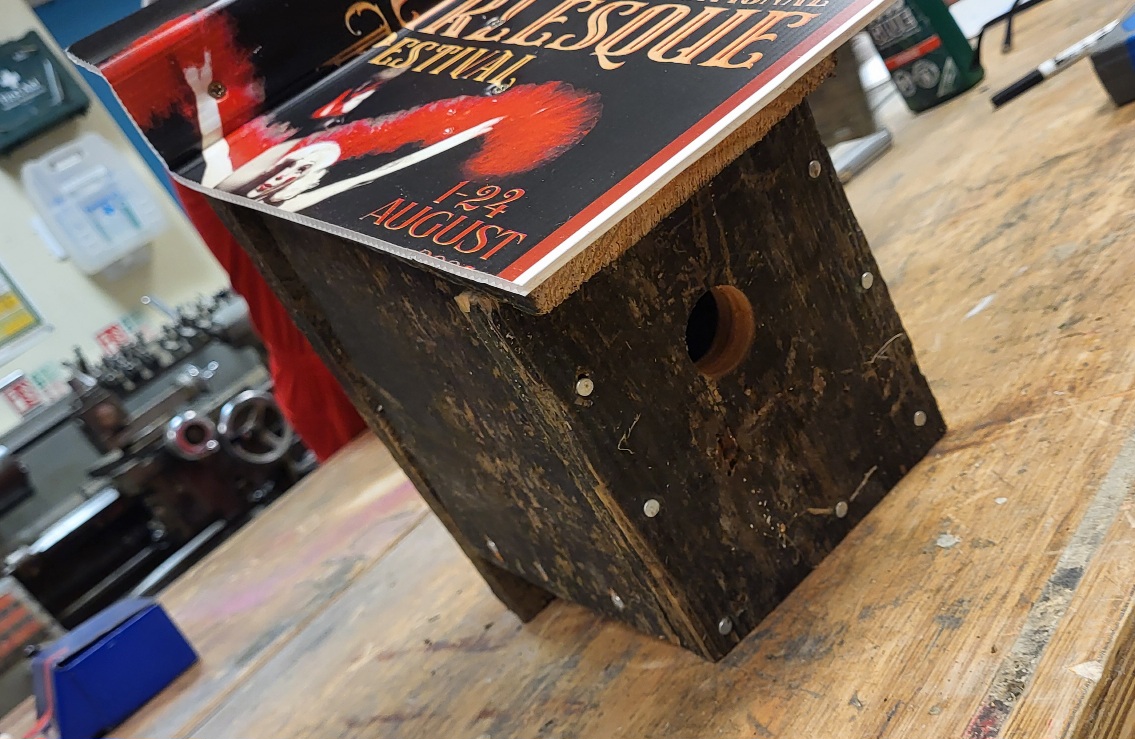
This is my first ever woodwork project! It's a basic birdbox design that you can make out of a single plank of wood. The roof is made from thick corrugated plastic that was a discarded poster from the Edinburgh Festival; it doubles as waterproofing and hinge.
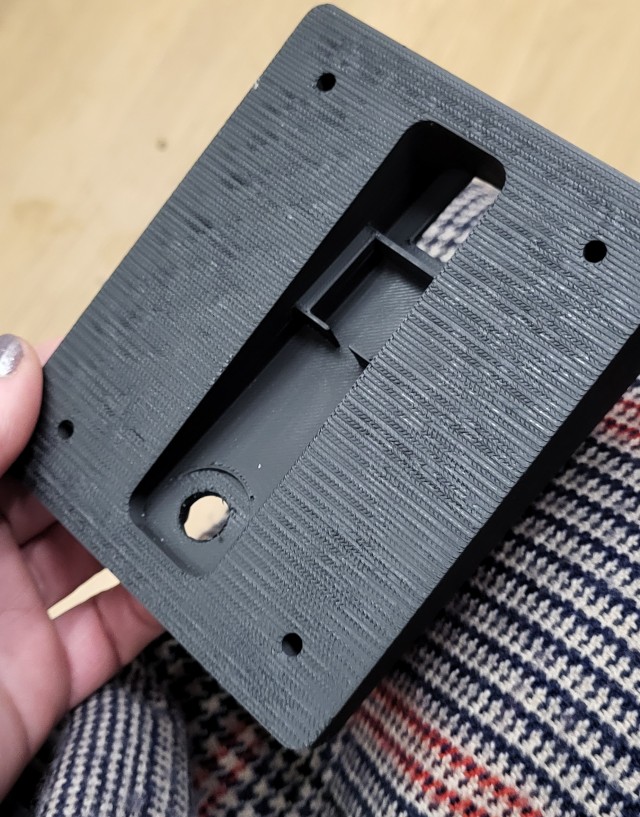
The 3D print shown here is Rob's custom design for the housing. Its wedge shape fits neatly inside the roof of the birdbox. There's a motion sensor, set at a slight angle to detect movement at the entrance to the box. At the other end there's space for a temperature-humidity sensor, and plenty in between. The top part of the housing is still a careful design progress - early iterations of the birdbox have shown Rob the need for bug-proof innards!
We had a range of other sensors to use in breadboard-based exercises and as conversation points - what if we added a thermal camera on the inside, or a microphone both on the inside and outside of the roof?
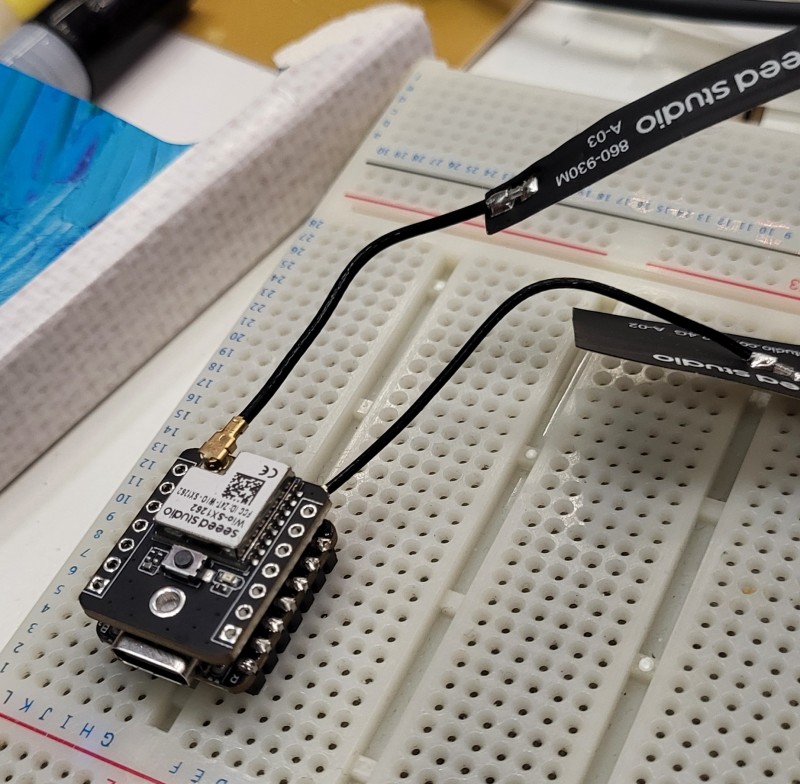
Specs for the components - the lines in green are in every kit, the others are optional extras, with a solar panel and charger to demonstrate one running installation in a field workshop:
|
Gravity: I2C Non-contact IR Temperature Sensor For Arduino (MLX90614-DCC) |
SKU: SEN0206 |
|
XIAO ESP32S3 & Wio-SX1262 Kit for Meshtastic & LoRa |
SKU: 106179 |
|
Mini PIR Motion Sensor |
SKU: 104420 |
|
LoRa Antenna with Pigtail - 868MHz Black |
SKU: 105078 |
|
MLX90641 IR Array Thermal Imaging Camera |
WAV-20465 |
|
USB-A to USB-C Cable - Black |
SKU: 105545 |
|
Seeed XIAO ESP32S3 Sense |
SKU: 106594 |
|
Maker Nano |
SKU: 102913 |
|
Adafruit I2S MEMS Microphone Breakout - ICS-43434 |
SKU: ADA6049 |
|
Adafruit bq25185 USB / DC / Solar Charger with 5V Boost Board |
SKU: ADA6106 |
|
Monocrystalline Silicon Solar Panel |
SKU: WAV-24166 |
We sent the invitation out far and wide - including to every environmental science Masters student in Edinburgh via the amamazing Phenoweb project, but had a few dropouts - see Learning points below for thoughts on how to make it more appealing - and attendance was weighted much more towards hackers than ecologists.
I'm grateful to [Ok to cite their name?] for sticking with us for both days of the workshop and sharing their hard-won experience of weeks spent on remote field sites, repeatedly surveying the conditions of nests, describing what researchers are looking for and how much difference a small amount of realtime information could make to our understanding of ecological changes.
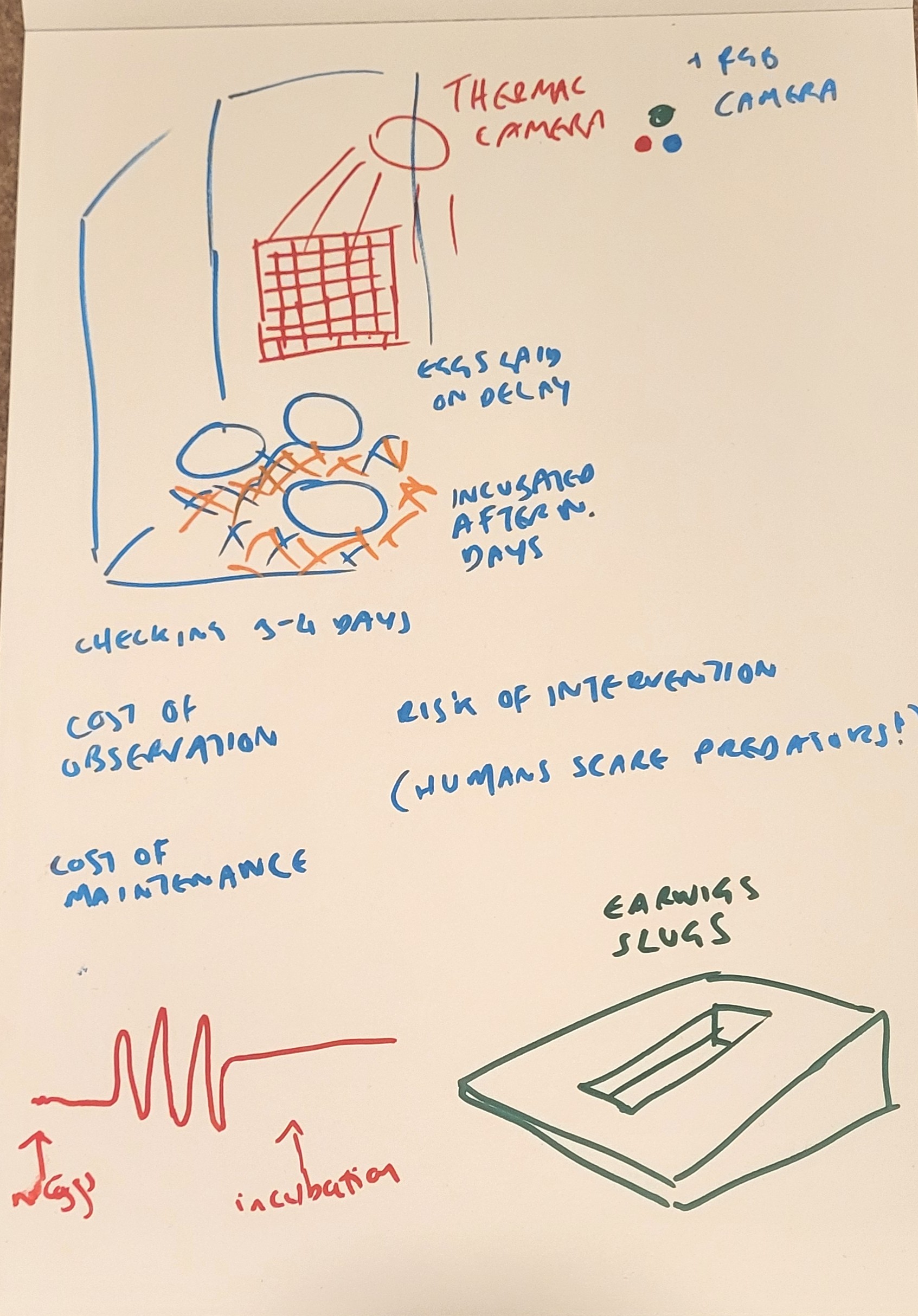
The thermal camera shown in the diagram here has a 32x32px readout - small enough to be encoded in a JSON object and sent in an MQTT message. Such cameras are cheap (though ironically more expensive than an RGB camera) and could be combined with their output. But do we want or need camera-based sensors for a lot of applications, where the same knowledge could be extrapolated from a temperature-based indicator?
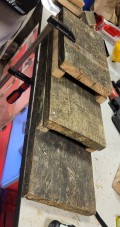
Meanwhile a couple of the most creative hackers i know were hanging back from the electronics entirely - either burned from past experiences of building LoRa sensor networks for applications they didn't enjoy, or finding more satisfaction in the purely manual parts. This beautiful batbox was built by a hacker who's also turned out a bat monitor in her spare time out of curiosity, but has no interest in the key role of bats as ecosystem sensors....
Learning points
Balance of interests
We are finding it challenging to get mainstream ecologists to engage with these workshops.
- Is it the setting? Ecologists do what they do because they want to spend time outside. Andy Quitmeyer spoke movingly about this at the last Open Hardware Summit - DINA Labs have build a makerspace in the field.
- Is it the timing? Our two indie workshops have run on a weekend, to avoid people having to use working hours. But perhaps researchers are more flexible with their time than "research technical professionals"
Scope of exercises
I was advised early in the Fellowship to try and narrow the scope of each workshop to a specific domain, or specific geographic area.
The birdbox project is lovely for this - it's a really concrete prototype with extension potential. It's both a labour of love and a research artefact. But having to wait for birds to come along and nest lacks the instant gratification factor of Nature Listening, immediately being able to use a Raspberry Pi to learn about your environment.
There's a balance between presenting something as a set exercise, and presenting a library of parts. The next iteration of this workshop, reusing the components, will
The physical sensor library works as a thought experiment; it works less well as a chat-along activity unless you've also got a library of virtual materials. To make the workshop an enjoyable experience you need a library of code and schematics as well as parts. Especially for relative beginners like me! There was Arduino code available, but micropython examples for each component would have helped a lot - I wish I'd been able to contribute this in advance.
I worked through the 12 Projects of Codemas advent calendar over the holiday to learn Micropython. It's a well-thought out kit that must have taken a lot of work to put together; an exploratory workshop would really benefit from having an introduction at this level, to close the gap between researchers and hackers - but also must have taken a lot of time and effort to prepare.
Timing of activity
Our workshop was spread over an evening and an afternoon, offering the option to do the building phase on the Friday night and experiment with the installation on the Saturday. In practise this offered too much flexibility - you either need more time, or less! For the EMF workshop, the plan is to run this with the birdbox in "Kea flatpack" form over a couple of hours - it'll look more like a product, but an open source one you can reconstruct and customise.
Impact and outcome
I want too many things from this programme - the opportunity to discover unexpected new kinds of science, to remind hackers how interesting the outside world is, to encourage researchers to pursue creative prototyping, and to foreground the reminder of the unexpected purposes to which our work can be put. Most of all, I'd like to move the dial on funder incentives - to treat open source hardware in the same way as we already treat open source research software, as a given for reproducible work - does science come out of a black box? And if we're mainly preaching to the converted - bringing people to workshops who are already engaged with OSH for research and want to do more - is that in any way directly offering funders the metric they need?