Cards Against Technology
- Backstory of the concept
- Iterations of the deck
When I hatched the plans for a Software Sustainability Institute Fellowship in 2025 I'd just witnessed a wonderful talk by Libby Miller on “Poking holes in reality with prototypes”. Mentions in passing this futuristic mushroom sensor that was the last of a series of 100 future objects - this one was designed in a hands-on workshop with school-aged children.
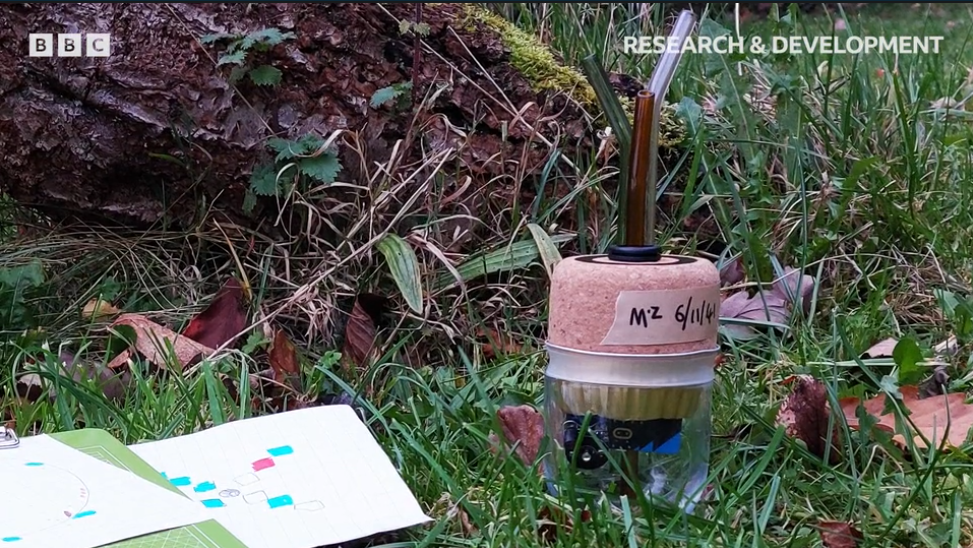
It took me a while to get any workshops off the ground. Past innovation work I've been involved in has been co-opted in destructive ways; I'm alive to the unintended applications of environmental sensing technology; a condition of continuing to work in tech is needing a way to ground invention in discussion of unintended uses, but do that in a way that avoids decision paralysis and doesn't cause bad feeling in people.
I like Dan McQuillan's concept of "decomputing" a lot - the tech equivalent of degrowth, or decolonialism. I reached out to Dan for recommendations for frameworks, methods, ways of thinking contructively about unintended reuse, and was pointed at The Matrix of Convivial Technology (sadly paywalled).
The basic ethical values and design criteria that guide these different groups in relation to technology are summed up into five dimensions: relatedness, adaptability, accessibility, bio-interaction and appropriateness. These dimensions can be correlated with the four life-cycle levels material, production, use and infrastructure to form the Matrix
You need a tool or prop to bring this discussion into a hands-on workshop. I thought back to another project of Libby's, done with jarkman: the Catwigs deck. Catwigs are an innovation filtering tool; help you decide what's important, and see if your project already carries the seeds of its own doom. I've used these in participatory planning exercises with past teams, and they've been illuminating.
So this is what Cards Against Technology are (name suggestions are welcome!)
- A card deck to spark thoughtful conversation
- About the purposes to which community sensing can be put
- And the shape of the infrastructures that we build
- How do they work? Like Pokemon or Top Trumps? Tarot? Oblique Strategies? Planning Poker? …
Card Deck - Iteration 1
I made this for the FDRI Open Source Hardware workshop. We've got a big index of the different "polarities" in the Matrix of Convivial Technology. This doesn't respect the five dimensions and the four lifecycle levels at all, they're just dumped into a big list.

Each term is written on a card (there are more of the "positive" ones because I did them first, then ran out of cards). To try it out and get some feedback, I listened to a discussion where Wouter Buytaert was describing the benefits of the FDRI infrastructure to a potential early adopter. Flipped through the deck and pulled out any card that seemed to fit what was being said.
That produced these seven cards which tell you about the design and the implications of it, there are four positive and three negative in this set.


The folks in that discussion said there were too many cards. There are a lot of near-duplicates, there are a handful I don't love (like "Right to creative input" - assumes a lot about whose right it is to offer. I'm not sure whether every pole needs its opposite pole in the deck - do you need "organisation decentralised" in there to move away from "organisation centralised"? On the train home I filtered out the remaining deck into a keep pile and a maybe pile


That's it, that's the deck. I'd be grateful for any input on how to make it have more of a game dynamic, am keen to preserve a vague air of mysticism, and definitely want to pursue funded collaborations to develop the deck and put it to good use for social invention.